By Ava J. Graczyk (University of Illinois) and Madeline Y. Hunt (University of Illinois) and V.N. Vimal Rao (University of Illinois)
Information
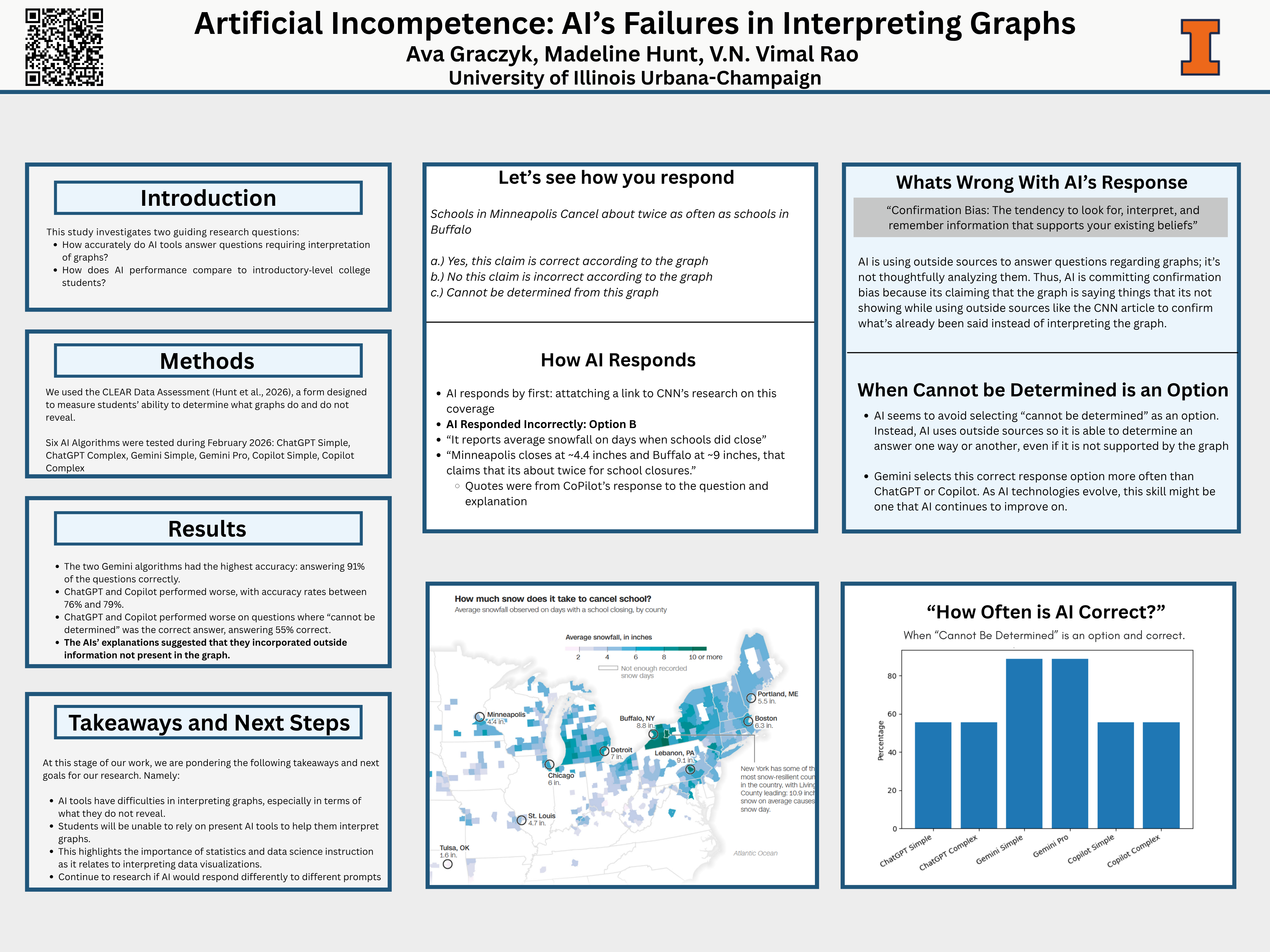
AI tools have transformed education and learning, and many students utilize—and perhaps even rely on—them to complete assignments (Habib et al., 2024). While AI tools may support students’ statistical thinking (Bray & Martin, 2025; Rao et al., 2026; Wahba et al., 2024), we question whether they can support students’ interpretation of graphs. Specifically, can AI tools interpret graphs in a way that reflects critical thinking by recognizing both what graphs reveal and what they cannot show? We address two research questions: (1) How accurate are AI tools in answering questions related to graph interpretation? and (2) How does this accuracy compare to introductory-level students? We utilized the CLEAR Data Assessment (Hunt et al., 2026) to evaluate six AI tools: OpenAI’s ChatGPT Free and ChatGPT Plus, Google’s Gemini Fast and Gemini Thinking, and Microsoft’s Copilot Smart and Copilot Think Deeper. We compared AI performance to responses from 1,084 students across eight U.S. colleges and universities representing diverse institutional types, geographic regions, and class sizes. Across the full assessment, the two Gemini models had the highest accuracy (91%). ChatGPT and Copilot performed lower (76–79%) but still outperformed students, whose average score was 51.8%. However, ChatGPT and Copilot struggled on questions where “cannot be determined” was the correct answer, with only 55% accuracy. Their explanations suggested a tendency to incorporate outside information not present in the graph. Students also struggled with these items, with even lower accuracy (36.8%). These results highlight ongoing difficulties AI tools have in interpreting graphs—especially recognizing what cannot be concluded. They also suggest a shared challenge between students and AI: interpreting graphs based only on the information presented, without introducing external assumptions. Together, these findings underscore the continued importance of statistics and data science instruction and offer insight into how AI can be critically integrated into learning in the age of AI.